
Amid the anti-denominational war we see a cry from the post-modern everyman; we want to understand transcendent universal truth. Post-moderns want to know what has been true across the vastness of the Christian tradition, and not the petty doctrinal disputes between sects. We want to be a part of something that makes a difference and that is bigger than ourselves. We want to be a part of something authentic. Where people aren't involved in scandal, or where nobody is fleecing us for our “own good.” Post-moderns can see a fake a mile off, we know when somebody is insincere, and we have no patience for us. There is this attitude I feel in every group of post-modern adolescents that screams for sincerity. Out of this we hear a call, a plea for teachers of good Orthodox theology. We want to know the truth, beyond the opinion. We are a part of the swing of the pendulum back to that which is held the most dear by the Church. We discover this brilliant teaching from Vincentius, a Gaul, wrote a treatise outlining the problems with Augustine's view of predestination called “the Commonitory.” He outlines an operating principal for the acquisition of theological understanding that I will embrace for all of my future academic pursuits. In order for us to fortify our minds against heresy and pop-theology we must look first to Scripture, and next to the Tradition of the Church; that which is universal, has been held by antiquity, and is consensual among believers. I will endeavor to delve into the vast pool of theology and to portray my understanding of its nature to the best of my ability.
One of the more interesting parts of my theological journey is simply the early years of my interest. I started my reading in my bedroom, apart from society. Whenever I would try to talk about it I was met with a consistent lack of interest. So frustrated I became with this that I internalized all of my thoughts. Untempered by society, and uncorrected by people of superior intellect my understandings remained narrow, and shallow. It wasn't until my time at Indiana Wesleyan that I finally felt encouraged, being able to discuss and ask deep questions. It has served as an invaluable part of my understanding of what it means to wrestle with theology. I have come to the understanding that theology is meant to be discovered in the context of community. That it is supposed to be discussed and corrected if one is to really learn and excel.
With these understandings I would like to state my intent for this paper. I am departing on a literary journey to accomplish four ends. First, to participate in the great conversation of theology, thus creating a framework by which to both teach those of lesser understanding, and to seek correction and guidance from those of higher understanding. Secondly, to create a reference point to steer my future theological pursuits. Thirdly, I aim to bring clarity to my systematic understanding, to be able to clearly convey the principles of theology in a coherent manor, and to create stock verbiage to use in my local church ministry. Lastly, but most importantly is to bring more strength and love to my relationship with God, the author and perfecter of our faith.
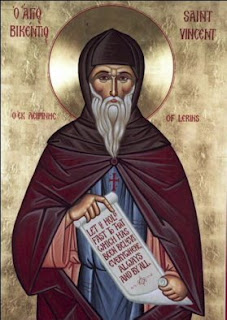 Vincentius (Vincent of Lérins) was an early church father who lived and wrote in Lérins, France. His contribution that deserves our attention is a work called the "Commonitory." It is often held that the Commonitory was a work by Vincentius meant to create a rubric where by the Christian might determine true Ecclesiastical Interpretation and Doctrine, from heresy. When one looks to address the Commonitory as a literary work it is by and large a refutation of Augustine's doctrine of Predestination. Most scholars would give a wide range of dates for the writing of the Commonitory, but the stream of thought that I want to present is that Vincentius wrote the Commonitory in 434, three years after the Ecumenical Council of Ephesus.
Now even as I said that the primary goal and purpose of the Commonitory is to refute the Augustinian doctrine of Predestination, his stance and verbage on searching out heresy is exceptional, and has now formed the foundation by which I view doctrine.
Vincentius would contest that due to the highly interpretive nature of Scripture, while complete and sufficient of itself, must be read through the lens of the Ecclesiastical Tradition. My theology professor Dr. Chris Bounds points out the ease with which an Evangelical discards the Tradition of the Church over time. The urging of Vincentius is to embrace the work done for us by those that have predated us. Outside of the Tradition one can easily diverge from Orthodoxy. It is nearly impossible for a person, independent of community, to arrive at an Orthodox understanding of scripture. I do not recall who said these words, but the effect was that "if we by chance see further than those that have gone before us it is because we have the privilege of standing on their shoulders." Thus, the collective work of the founders of our faith gives strength to our understanding, apart from which we would fall into heresy.
Vincentius also sets up a series of beautiful tools by which the Christian can check the authority of a doctrine. He states that we must look to the Universality of a doctrine. To see if it is accepted by Christians everywhere. Assuming, as we must, that there is one and only one faith that is true for all. Secondly we look to the Antiquity of a doctrine. It begs of a doctrine its authority based on its age. This is HUGE! There is a law within the pursuit of theology called the law of "Proximal Authority." It states that the closer a thought is to the chronological date of Christ, as Christ is the insertion of the ultimate authority on theology into time, the more weight it must hold in our hearts. That something said by Jesus is chief, followed closely by His disciples, then the Apostolic Church Fathers, followed then by the Greek and Roman Fathers and on down the line to the theologians of our day. Thus we are presented with our third rule which is the position of the Doctors of our faith.
Consensus within the Church on a doctrine can be arrived at by looking to the past. One must see everything through the eye of Consensual Theology. What has been agreed on over time? We must take great care, looking to see if any general or Ecumenical councils have been assembled over, or have spoken to the issue at hand. If not one must look to the collective wisdom of the fathers of our faith. I, in my naivety, fail to truly appreciate the severity of the nuances of doctrine. A statement that would send shutters down the spine of a more learned wise man, is uttered with total apathy from my lips. I, and those like me, must, absolutely must lean into, and run with fervency toward understanding, lest we truncate the essence of our Lord.
I will leave you with an image that Vincentius uses to speak to the progression of understanding of doctrine. He compares the evolution of doctrinal understanding to the growth of the human body. Canon lays the foundation in the womb of our understanding. The general anatomy of doctrine is forged in the sacred Scriptures, and through time theologians of old have formed and nurtured it. Growing it into a more mature understanding. Taking great care not to change an element of it, because we believe that it holds within it the capacity to grow to it intended state. It is logical that when one begins with a boy, it will become a man. Theologians then form doctrine within the constructs of Scripture arriving, in time, at holistic understanding. Articulating elements that were unclear in the text, and emphasizing those areas that require assertion. So now when one takes the cumulative works of Canon and the texts of the Traditions, one is able to experience the fullness of the understanding of God, and to that end we strive.


